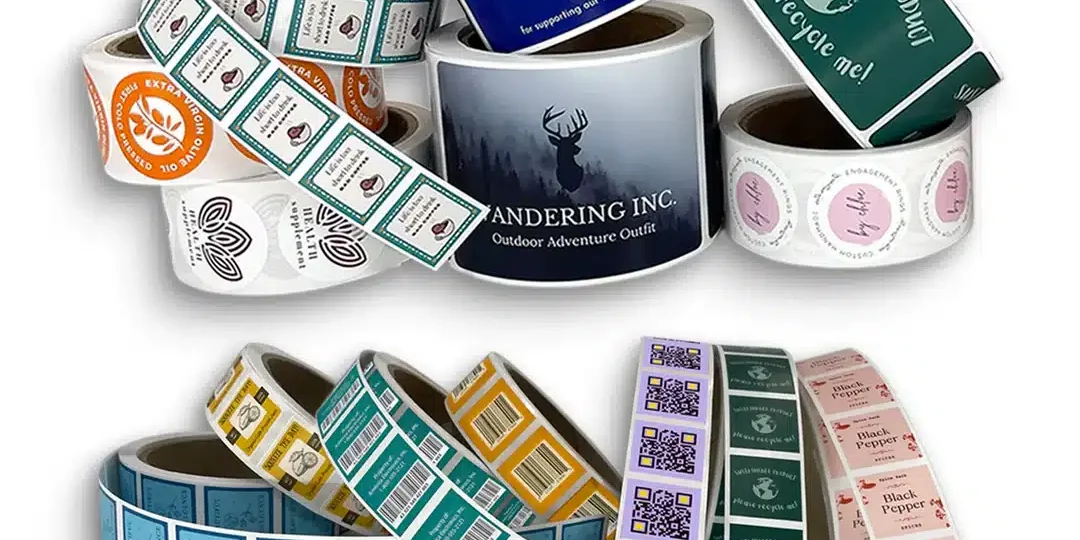
If you’re planning a labeling project, you’ve probably heard the terms roll labels and stickers used interchangeably. While they’re closely related, there are important differences that can affect how your labels are applied, produced, and used.
This guide breaks down the differences between roll labels and sticker labels so you can choose the right option for your next project.
What Are Roll Labels?
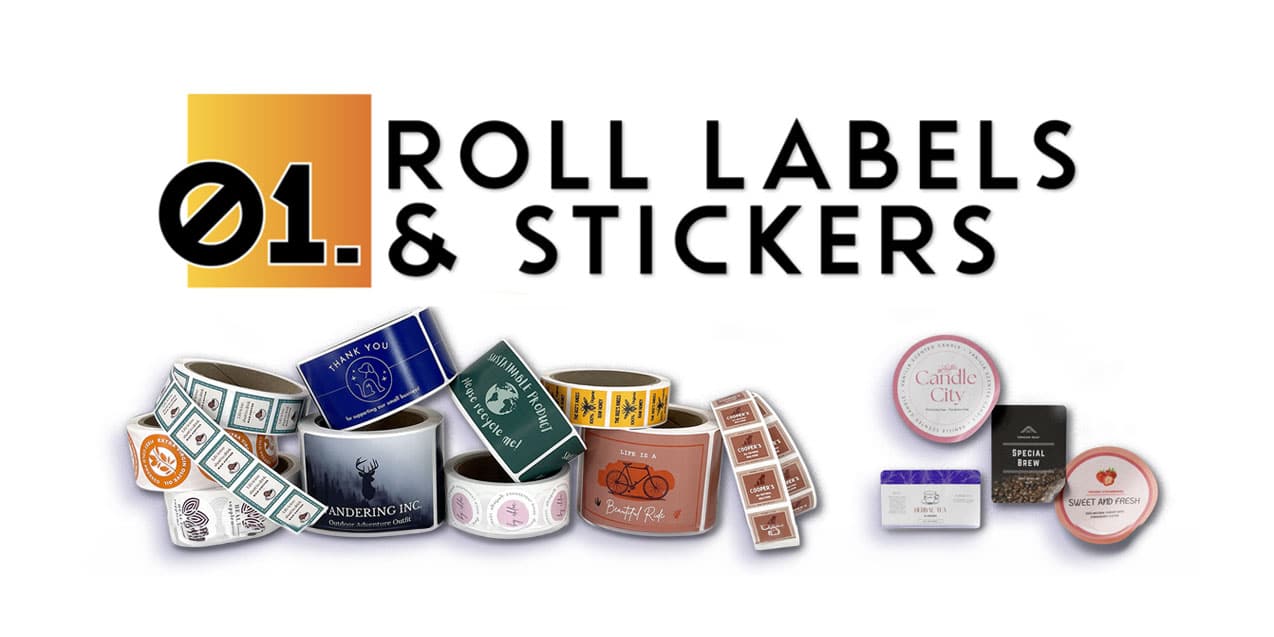
Roll labels are labels supplied on a continuous roll. They’re designed for efficient application and are commonly used in production environments where speed and consistency matter.
Roll labels are typically applied using:
- Automated labeling machines — ideal for high-speed production lines
- Semi-automatic dispensers — a good middle ground for growing businesses
- Manual peel-and-apply — still faster than sheet labels for higher-volume projects
Because they’re produced on rolls, they’re ideal for consistent application across larger quantities — think product packaging, food and beverage containers, cosmetics, and health supplements.
What Are Sticker Labels?
Sticker labels are typically supplied in sheets or as individual die-cut pieces. They’re often used for smaller quantities or situations where labels are applied by hand.
Common uses for sticker labels include:
- Promotional giveaways and event handouts
- Small-batch or seasonal packaging
- Branding and marketing materials
- Team or personal self-expression
Stickers offer flexibility, but they’re generally less efficient when you need to label hundreds or thousands of products.
Key Differences Between Roll Labels and Stickers
Application Method
Roll labels are built for speed and consistency, especially when applied with automated machines or dispensers. Sticker labels are better suited for manual application and lower quantities.
Production Volume
Roll labels are the go-to for medium to large production runs — typically 500 units and up. Sticker labels work well for short runs, limited editions, or one-off projects where you might only need a few dozen to a few hundred.
Consistency and Efficiency
Because roll labels feed through a machine or dispenser, they help maintain consistent placement and orientation on every package. That’s especially important for retail shelf presence and regulated products that require specific label positioning. Sticker labels offer more creative flexibility, but at the cost of efficiency at scale.
Common Use Cases
Roll labels are commonly used for:
- Product packaging and retail goods
- Food, beverage, and supplement labeling
- Manufacturing and warehouse operations
- Regulated products (pharmaceuticals, cosmetics, cannabis)
Sticker labels are frequently used for:
- Promotional campaigns and trade shows
- Branding inserts and packaging accents
- Temporary labeling and seasonal products
- Personal expression, sports teams, and events

Which Option Is Right for Your Product?
The best choice depends on how your labels will actually be used. Ask yourself:
- How many labels do I need? — Higher quantities favor roll labels.
- How will they be applied? — Machine application requires rolls; hand application works with either.
- What surface are they going on? — Curved bottles, flat boxes, and textured surfaces each have different needs.
- What’s the production environment? — Warehouses and production lines benefit from roll efficiency.
- Will I need multiple versions or sizes? — Digital printing on rolls makes versioning easy.
For businesses producing packaged goods or operating in regulated environments, roll labels are almost always the most practical solution.

Understanding Label Dies and Unwind Positions
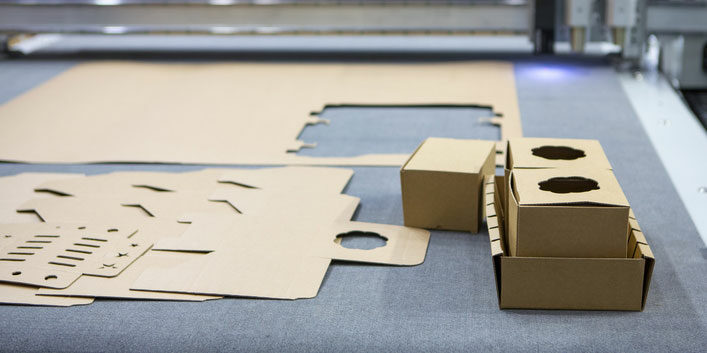
If you’re new to roll labels, you’ll hear the term “die” come up often. A die is a specialized cutting tool that shapes each label as it’s produced — the image below shows how a die works and what one looks like in practice.
One detail that catches many first-time buyers off guard is unwind position. When labels are applied by machine, the roll needs to feed in a specific orientation so the label lands right-side-up on your product. There are four standard unwind positions (numbered 1–4), and your label printer will need to know which one your applicator requires before production begins.

How Printing Method Fits In
Both roll labels and sticker labels can be produced using different printing methods. Digital printing is commonly used for shorter runs, multiple versions, and faster turnaround. Flexographic printing is typically used for longer, high-volume runs where per-unit cost is the priority.
The printing method impacts cost, flexibility, and turnaround time — which is why it’s important to evaluate both the label format and the production approach together when planning your project.
Next Steps: Explore Your Label Options
This guide is meant to clarify terminology and help you understand the basics. When you’re ready to move forward with a labeling project, here’s where to go next:
- Both formats are covered on our custom label printing page, including which material and adhesive suits each container.
- Custom Roll Labels— Explore TPS’s Roll Label capabilities.
- How to Choose the Right Roll Labels for Your Product — A deeper guide covering materials, adhesives, and finishes.
- Request a Custom Quote — Tell us about your project and we’ll help you find the right solution.
Have questions about which label type is right for your product? Contact the TPS Printing team — we’ve been helping San Diego businesses with custom labels and packaging for over 40 years.